




Blockchain has not entered mainstream finance by replacing banks. It is entering by being absorbed into the regulated machinery of money, securities and collateral.
The history of blockchain began with Bitcoin in 2009. For much of the following 15 years, blockchain technology and crypto-assets were perceived as inseparable. A largely unregulated ecosystem developed outside the traditional financial perimeter, producing utility tokens, stablecoins, security tokens and other digital representations of value. It was a period of genuine innovation, but also one frequently characterised as a “Wild West”, marked by speculation, legal uncertainty, inconsistent controls, fragmented markets and repeated failures of governance and custody.
These conditions did not prevent digital assets from developing, but they made it difficult for blockchain-based instruments anchored to the traditional financial system to achieve institutional trust, integration and scale. Banks and other regulated institutions could experiment with the technology, yet deploying it within established financial products required greater certainty around ownership rights, settlement finality, compliance, operational resilience and regulatory treatment.
That picture is now becoming outdated. The centre of gravity is shifting from the creation of predominantly crypto-native assets towards the representation and movement of familiar financial claims on programmable infrastructure. Banks, asset managers, custodians, exchanges and central banks are using blockchain technology for activities they have always performed: moving commercial-bank money, issuing bonds, administering funds, financing securities, managing collateral, safeguarding assets and settling transactions. A regulated stablecoin or tokenised deposit may be technologically innovative, but the value it represents is deliberately traditional. The same is true of tokenised government bonds, money-market funds and other established financial instruments.
This does not mean that crypto-assets are disappearing or that every financial service will move onto a blockchain. It means that blockchain’s institutional relevance no longer depends on creating an exotic new asset class. Increasingly, the assets, institutions and services are familiar; it is the infrastructure and functionality that are changing. Around-the-clock availability, programmable transactions, atomic settlement and shared records can allow regulated financial institutions to provide existing services more efficiently while introducing capabilities that legacy systems were not designed to support.
For financial institutions, the question is therefore no longer whether blockchain belongs only to the crypto economy. It is where this technology can improve the services they already provide, create new sources of value and reshape the financial infrastructure on which their businesses depend.
Adoption is still uneven. The Financial Stability Board described DLT-based tokenisation as low but growing in 2024, and that remains a useful corrective to the industry's largest forecasts.[2] At the same time, selected platforms have reached meaningful operating volume: J.P. Morgan's Kinexys reported more than US$3 trillion processed since inception and over US$5 billion on an average day by April 2026, while Broadridge's distributed-ledger repo platform reported US$339 billion in average daily volume in September 2025.[3][12] Blockchain is therefore neither a universal replacement for financial infrastructure nor a science project. It is becoming a specialised production architecture where shared state, programmability and continuous settlement solve a sufficiently valuable problem.
The adoption map: four layers are developing at once
Institutional adoption is easiest to understand as four connected layers.
First, money is becoming programmable. Banks are issuing tokenised representations of deposits, regulated entities are issuing fiat-backed stablecoins, and central banks are testing tokenised reserves for wholesale settlement. These instruments are not interchangeable. They carry different claims, redemption rights, balance-sheet effects and regulatory obligations.
Second, financial assets are being issued or represented on-chain. Digital bonds, fund shares, structured products and private-market interests are moving from demonstrations into regulated issuance and servicing. The token is not the investment thesis; it is a new operating wrapper around a legal claim.
Third, collateral and post-trade processes are being redesigned. Repo, margin and collateral workflows are attractive because faster movement, atomic delivery-versus-payment and a common transaction record can translate directly into lower operational friction and better use of liquidity.
Fourth, connective infrastructure is emerging. Swift, central banks and market infrastructures are working on the interoperability and settlement layer needed to prevent isolated blockchain networks from becoming a new generation of silos.
Selected institutional initiatives and their maturity
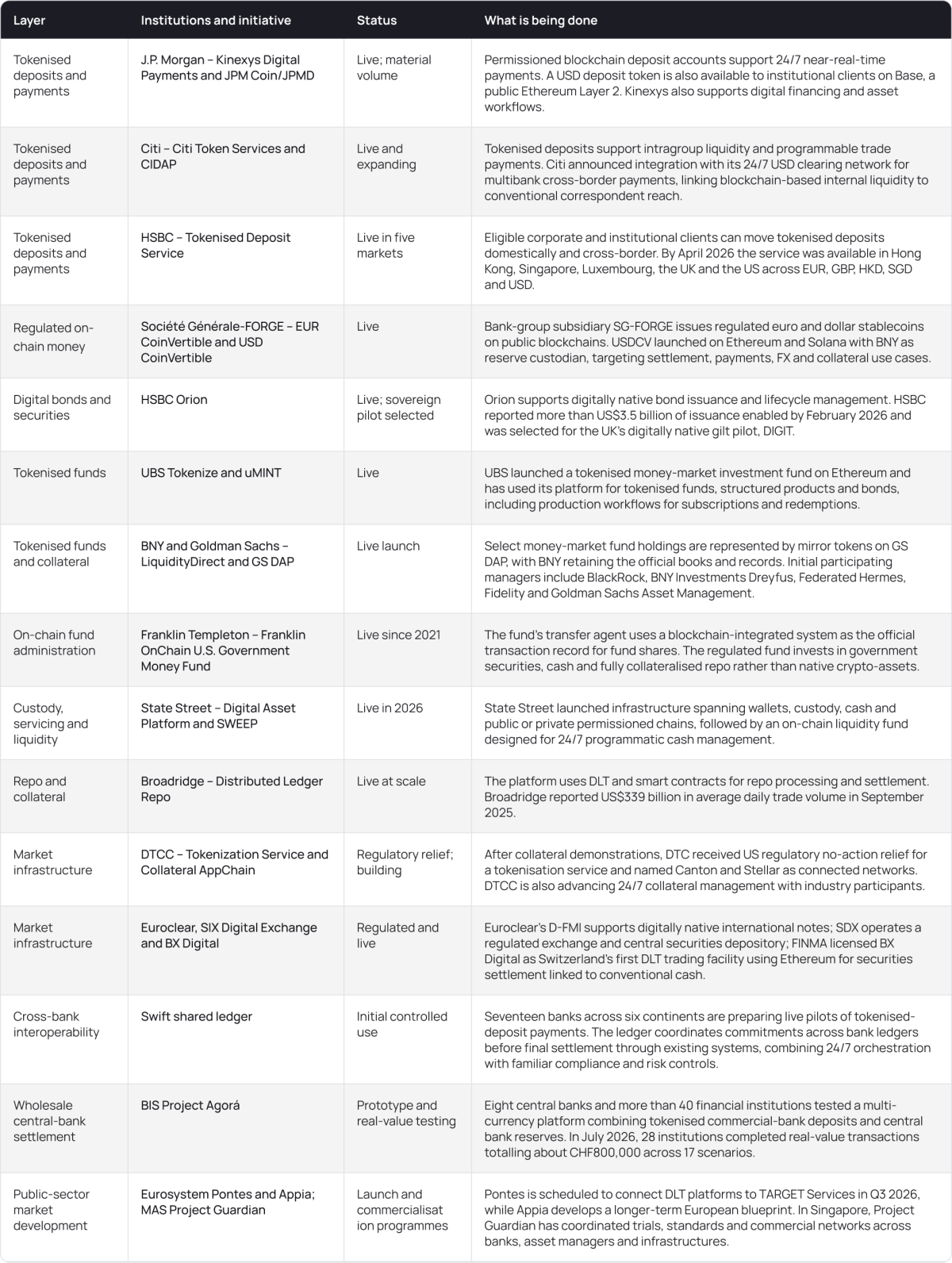
This map is representative rather than exhaustive. It nevertheless shows that adoption is not confined to one product or one type of institution. Transaction banks, custodians, asset managers, exchanges, central securities depositories, messaging networks and central banks are all trying to define their role in a more programmable market structure.
Why large financial institutions keep investing
The industry's motivations are more practical than ideological.
Corporate clients operate continuously; banking infrastructure often does not
Multinational treasurers manage entities, suppliers and collateral across time zones. Cut-off times, batch windows and correspondent chains create trapped liquidity and uncertainty. Tokenised deposits allow a bank to offer continuous transfer and programmable controls while preserving a commercial-bank claim. Citi's integration of Token Services with 24/7 USD clearing and HSBC's cross-market deposit service illustrate the direction: blockchain is being connected to the banking network, not positioned as a parallel universe.[4][5]
Reconciliation is a large, persistent cost
Traditional transactions leave multiple institutions maintaining their own records and reconciling differences after the event. A shared ledger can give authorised participants a synchronised view of ownership and transaction state. When identity, asset and cash records are coordinated, exceptions and manual hand-offs can fall. This is particularly valuable in multi-party processes such as syndicated assets, funds, collateral and trade finance.
Programmability changes the transaction, not only its speed
Smart contracts can bind payment to a condition, coordinate delivery and payment, calculate distributions, enforce transfer restrictions, or automate lifecycle events. The BIS describes tokenisation as a way to integrate messaging, reconciliation and asset transfer into a single operation; the ECB similarly highlights the potential to bundle issuance, trading, settlement, custody and servicing on one platform.[1][18] This is the deeper opportunity: an asset becomes an executable financial object rather than a static database entry passed through sequential systems.
The future revenue pools are adjacent to core banking franchises
If securities and money become tokenised, the relevant services still include issuance, deposits, FX, financing, custody, collateral, fund administration, compliance and data. Banks are investing to defend these franchises, but also to recombine them. A tokenised fund that can be transferred or pledged more easily may create new custody, financing and distribution flows. A tokenised deposit can preserve a banking relationship that might otherwise migrate to a non-bank stablecoin issuer.
Institutions want influence over standards and market structure
The network choices made now - identity frameworks, token standards, settlement assets, governance and interoperability - may determine who controls access and economics later. Participation creates institutional knowledge and a voice in emerging rules. Waiting for a single winning blockchain may feel prudent, but it also means allowing competitors and infrastructure providers to set the interfaces.
What blockchain improves - and what it does not
The clearest benefits appear when several parties need to update a shared transaction state and no single party can efficiently own the entire workflow.
- Faster, continuous settlement. Assets and money can move outside conventional windows, reducing the time between agreement and completion.
- Atomic exchange. Delivery-versus-payment or payment-versus-payment can make linked legs succeed together or fail together, reducing principal and settlement risk.
- Lower reconciliation burden. A common authoritative state can reduce duplicative records, breaks and manual investigation.
- Programmable controls. Eligibility, transfer restrictions, corporate actions and conditional payments can be embedded in governed code.
- Collateral mobility. Near-real-time visibility and transfer can improve collateral allocation, release idle assets and support intraday financing.
- New distribution and product design. Digital units can support smaller denominations, new channels, automated servicing and combinations of cash and assets that are difficult on legacy rails.
- Traceability. Tamper-evident records can improve audit trails and provide more timely transaction information to permitted participants.
These advantages are not automatic. A conventional database or modern instant-payment rail may be cheaper for a simple process controlled by one institution. Instant gross settlement can also increase liquidity requirements if it removes the benefits of netting. Atomic settlement reduces one class of risk, but it does not eliminate credit, market, liquidity, legal or operational risk.
The principal constraints are now well understood:
- Fragmentation and interoperability. Multiple private networks, public chains and legacy systems can recreate the silos blockchain was meant to remove. Swift's work is important precisely because connectivity is not inherent.[16]
- Legal certainty. The token must confer enforceable rights, including in insolvency, and settlement finality must be clear across jurisdictions.
- Privacy and identity. Financial institutions need selective disclosure, reliable identity, sanctions screening and transaction monitoring without exposing confidential positions.
- Technology and operational resilience. Smart-contract errors, compromised keys, network outages, bridges and third-party dependencies create new failure modes. A 24/7 product also requires a 24/7 operating model.
- The settlement asset. A tokenised security is only as useful as the cash leg available to settle it. Deposit tokens, stablecoins and central-bank money have different risk and reach.
- Economics and liquidity. Tokenisation does not create buyers. A technically elegant instrument with no distribution, market-making or collateral utility remains illiquid.
The FSB's warning is therefore balanced: tokenisation may improve efficiency and transparency, but scaling could transmit familiar vulnerabilities - liquidity mismatch, leverage, interconnectedness and operational fragility - through faster and more complex channels.[2]
Is blockchain finally shifting away from crypto?
Yes in purpose; no in infrastructure.
The purpose of leading institutional projects is increasingly to move regulated claims: bank deposits, government and corporate bonds, money-market funds, gold, repo collateral and central-bank reserves. Unbacked crypto-assets are not central to these designs. The Basel framework itself distinguishes qualifying tokenised traditional assets from higher-risk crypto-assets and can apply the same credit-risk treatment as the non-tokenised asset when legal and risk conditions are met.[23]
Yet institutional finance is not simply retreating to closed databases. J.P. Morgan's JPMD is available on Base; UBS's uMINT uses Ethereum; SG-FORGE deploys regulated money on public chains; Franklin records fund-share activity across public blockchain networks; and BX Digital settles securities on Ethereum.[3][7][8][10][15] Public networks offer distribution, common technical standards and composability. Permissioned systems offer privacy, governance and controlled participation. The emerging architecture is likely to be hybrid: regulated assets and identities moving across a mix of public, permissioned and conventional rails.
Stablecoins sit directly across this boundary. They began as cash instruments for crypto markets, but regulated versions are being designed for payments, settlement and treasury. They also create risks around reserves, redemption, financial crime, monetary sovereignty and bank funding. The most accurate conclusion is therefore not that blockchain is leaving crypto behind. It is that blockchain is moving beyond crypto-only use cases while selectively importing the useful properties of crypto networks.
Regulation is becoming a design parameter
The regulatory debate has moved from whether digital assets should be addressed to how different claims, issuers and infrastructures should be governed.
- European Union. MiCA's stablecoin provisions have applied since June 2024 and the full regime since December 2024. In 2026 the European Commission opened a review of the framework. For tokenised financial instruments already governed by securities law, the separate DLT Pilot Regime provides controlled exemptions; ESMA has recommended changes to make the regime permanent after limited early uptake and growing applicant interest.[20][21]
- United States. The GENIUS Act became law in July 2025, establishing a federal framework for payment stablecoins that includes permitted issuers, reserve backing, redemption and disclosure requirements. This creates a clearer perimeter, while implementation and the treatment of broader tokenised markets continue to evolve.[22]
- Global prudential rules. The Basel crypto-asset standard and disclosures became effective on 1 January 2026. Qualifying tokenised traditional assets can fall into Group 1a, but banks must demonstrate legal equivalence, manage technology risks and continuously assess classification conditions.[23]
- United Kingdom and Switzerland. The UK's Digital Securities Sandbox is hosting the digitally native gilt pilot, while Switzerland's DLT Act supports regulated trading and settlement infrastructure. These approaches use supervised environments to connect legal finality with technical experimentation.[15][24]
- Hong Kong and Singapore. Hong Kong's stablecoin regime took effect in August 2025 and the first two issuer licences were granted in April 2026, including to HSBC. Singapore's Project Guardian has focused on coordinated commercial networks, common frameworks and settlement infrastructure rather than isolated pilots.[19][25]
Regulatory clarity is improving, but regulatory convergence is not. A product's legal claim, issuer, reserve model, customer type, chain, custody model and jurisdictions must be designed together. Treating compliance as a final approval gate is one of the fastest ways to strand a technically successful pilot.
The opportunity for institutions that are behind
Late movers do not need to copy every initiative. They need to decide where their existing advantages - licences, balance sheet, client relationships, risk capabilities and distribution - create a defensible role.
The near-term opportunities include:
- Transaction banking: tokenised deposits, programmable treasury, intragroup liquidity and cross-border settlement.
- Capital markets: digital issuance, tokenisation agents, paying-agent services, transfer agency and lifecycle automation.
- Securities services: custody, wallets, key management, fund administration, corporate actions and on-chain data.
- Financing and collateral: tokenised repo, margin mobility, intraday liquidity and the use of tokenised funds or government securities as collateral.
- Wealth and asset management: digitally native funds, new distribution channels and portfolios that can be rebalanced or collateralised programmatically.
- Infrastructure and compliance: identity, transaction monitoring, interoperability, smart-contract assurance and 24/7 operational controls.
What laggards risk losing is broader than a first-mover headline. They may lose corporate operating deposits to more programmable forms of money; servicing and custody mandates as assets migrate; financing flows where collateral can move continuously; influence over standards; and scarce practical expertise. The most important gap is the learning curve. Production readiness depends on legal, treasury, risk, operations, security and product teams learning together - knowledge that cannot be purchased instantly after a market standard emerges.
A pragmatic route from interest to launch
The strongest programmes start with a financial problem, not a preferred chain.
- Select a valuable, bounded workflow. Identify a client pain point with multiple parties, reconciliation cost, settlement delay or trapped liquidity. Establish the current cost and failure baseline.
- Define the claim and the money leg. Decide whether the product represents a deposit, security, fund interest, stablecoin or other right; specify redemption, finality, custody and insolvency treatment.
- Choose architecture against requirements. Compare public, permissioned and hybrid models for privacy, governance, resilience, distribution, interoperability and total cost. Avoid assuming that one network will serve every use case.
- Build controls into the product. Identity, AML/CFT, sanctions, permissions, key recovery, code governance, cyber resilience, accounting and regulatory reporting belong in the design, not in a post-pilot workstream.
- Test the entire operating model. Include onboarding, funding, exceptions, reversals, corporate actions, outages, incident response and 24/7 support - not only the happy-path smart contract.
- Use measurable production gates. Track settlement time, failed trades, manual touches, liquidity usage, collateral availability, onboarding time, unit cost, uptime and active-client adoption. Scale only when the economics and controls are credible.
The strategic question has changed. It is no longer whether blockchain can record and transfer financial value. Live systems have answered that. The question is where the technology produces enough client value and operating advantage to justify a new market structure - and which institutions will own the trusted services around it.
For institutions still observing, the opportunity is not to join a technology trend. It is to redesign a part of the financial value chain before the interfaces, economics and client expectations harden around someone else's platform.
Sources
- Bank for International Settlements, “The next-generation monetary and financial system,” Annual Economic Report 2025, 24 June 2025. View source
- Financial Stability Board, “The Financial Stability Implications of Tokenisation,” 22 October 2024. View source
- J.P. Morgan, “Latest milestones at Kinexys by J.P. Morgan,” 28 April 2026. View source
- Citi, “Citi Integrates Citi Token Services with 24/7 USD Clearing,” 29 September 2025. View source
- HSBC, “HSBC Expands Tokenized Deposit Service to the United States,” 13 April 2026. View source
- HSBC, “HSBC Orion awarded DIGIT platform mandate,” 12 February 2026. View source
- Société Générale-FORGE, “SG-FORGE to launch a USD stablecoin on Ethereum and Solana,” 10 June 2025. View source
- UBS, “UBS Asset Management launches its first tokenized investment fund,” 1 November 2024. View source
- BNY, “BNY and Goldman Sachs Launch Tokenized Money Market Funds Solution,” 23 July 2025. View source
- Franklin Templeton, “Franklin OnChain U.S. Government Money Fund,” product page and prospectus, accessed 3 August 2026. View source
- State Street, “State Street Launches Digital Asset Platform to Power Tokenized Finance,” 15 January 2026; and “State Street Investment Management and Galaxy Digital Bring Cash Management Onchain,” 5 May 2026. Source 1 | Source 2
- Broadridge, “Broadridge’s Distributed Ledger Repo Platform Processes $339 Billion in Average Daily Trade Volumes in September,” 13 October 2025. View source
- DTCC, “The DTCC Tokenization Journey,” June 2026; and “DTCC Announces New Platform for Tokenized Real-time Collateral Management,” 2 April 2025. Source 1 | Source 2
- Euroclear, “Euroclear launches DLT solution for the issuance of digital securities,” 24 October 2023. View source
- FINMA, “FINMA licenses first DLT trading facility,” 18 March 2025. View source
- Swift, “Swift’s blockchain ledger ready for use as 17 banks set to pioneer tokenised cross-border payments,” 9 July 2026. View source
- Bank for International Settlements, “Project Agorá: exploring tokenisation of wholesale cross-border payments,” updated July 2026. View source
- European Central Bank, “Eurosystem Unveils Appia Roadmap for Europe’s Tokenised Finance,” 11 March 2026. View source
- Monetary Authority of Singapore, “MAS Announces Plans to Support Commercialisation of Asset Tokenisation,” 4 November 2024. View source
- European Commission, “Crypto-assets,” updated 2026. View source
- European Securities and Markets Authority, “ESMA suggests amendments to the DLT Pilot Regime to make it permanent,” 25 June 2025. View source
- U.S. Congress, GENIUS Act, Public Law 119-27, signed 18 July 2025. View source
- Basel Committee on Banking Supervision, “SCO60 - Cryptoasset exposures,” effective 1 January 2026. View source
- HM Treasury, “Update on the procurement for Digital Gilt Instrument (DIGIT) Pilot,” 12 February 2026. View source
- Hong Kong Government, “Development and regulation of stablecoins,” 10 June 2026. View source
- FINMA, “FINMA issues first-ever approval for a stock exchange and a central securities depository for the trading of tokens,” 10 September 2021. View source
This article is for general informational purposes and does not constitute legal, regulatory or investment advice.