




There is a pattern in how transformative technologies actually spread. Social media advertising overtook print spending globally in 2019, fifteen years after Facebook launched [1].
Dematerialised securities are now the standard in every major capital market, yet Germany still maintained physical paper certificates at its central depository well into the 2010s. The pattern is consistent: transitions take longer than the early adopters expect, and when the tipping point arrives, the impact is bigger than imagined.
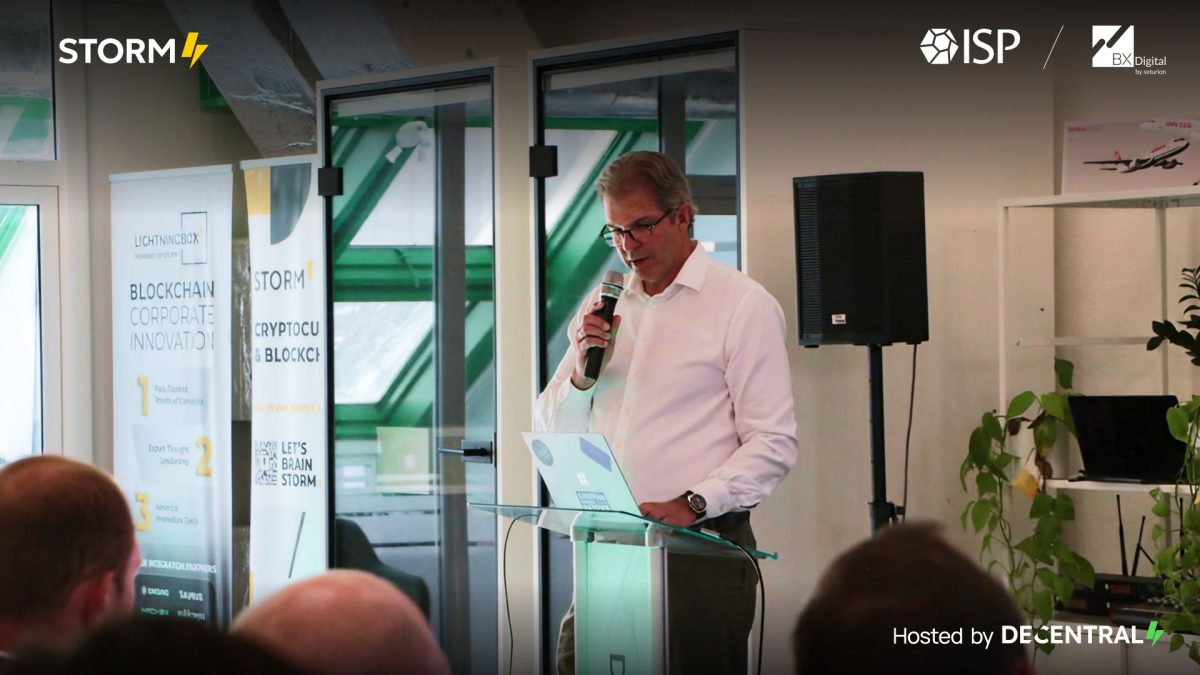
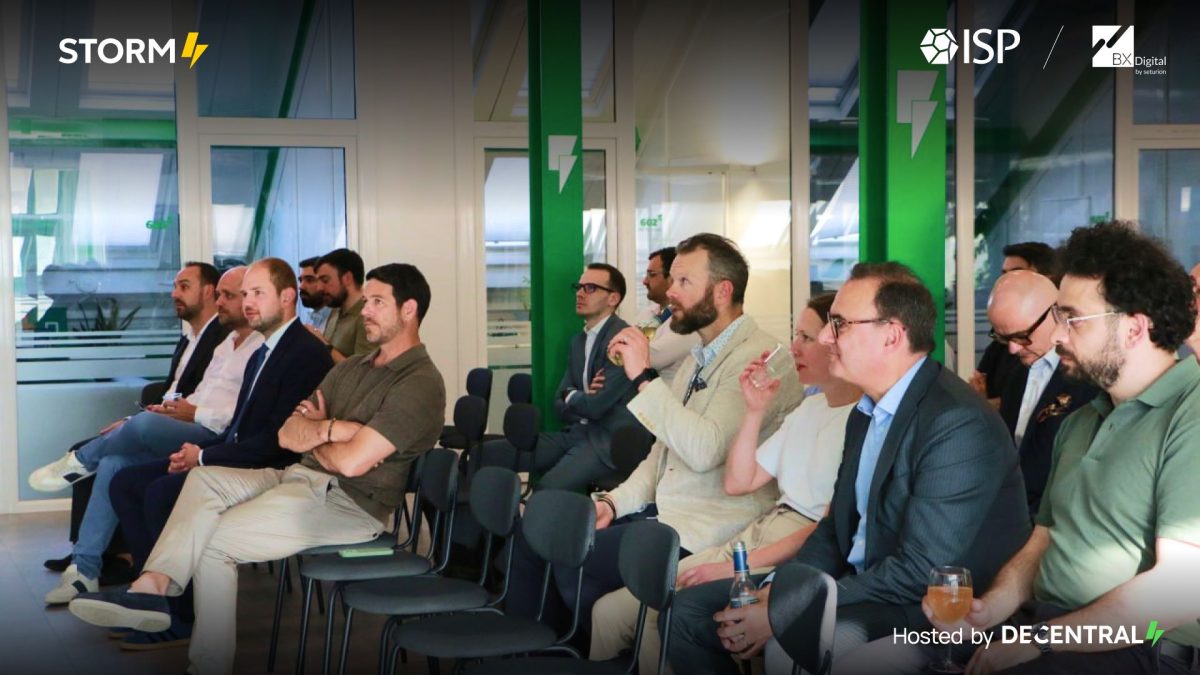
On the evening of May 26, Claudio Tognella of BX Digital and Tom Rieder of ISP Group spent an hour at Decentral House in Geneva making the case that tokenised securities are somewhere in that same arc. Not at the beginning, not yet at the end, but close enough to the inflection point that the infrastructure decisions being made right now will determine who captures the upside when it comes.
What made the evening worth attending, and worth writing about, is that neither speaker was selling a vision. They were describing an operational reality, with the ambiguities and unsolved problems included.
Switzerland built the first regulated securities exchange to settle on public Ethereum against FIAT currency. Here is what that means in practice.
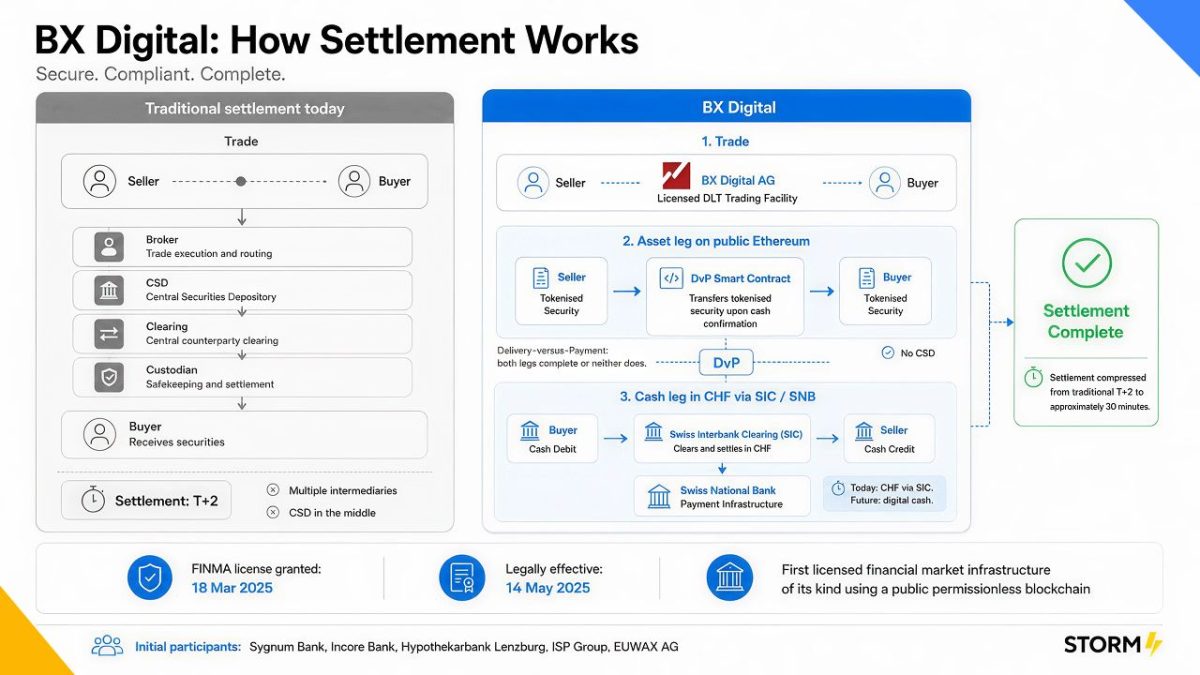
Consider what happens when a bond changes hands today. The trade executes, and then a chain of instructions moves through the system: from the custodian to the central securities depository, through the clearing layer, back out to the counterparty's custodian, with each step adding time, cost, and a small but real probability that something breaks. In most markets that chain takes two business days to complete. The coupon payment for that same bond, routed through the same intermediary stack, can take longer. Moving a custody account across borders is so operationally painful that advisors sometimes, e.g., in the case of private market funds, recommend clients simply sell their positions and repurchase them at the new institution rather than attempt the transfer.
BX Digital, the Swiss subsidiary of Seturion on and part of the Boerse Stuttgart Group, was built to replace that architecture. On March 18, 2025, FINMA granted it the world's first DLT trading facility license under Switzerland's 2021 DLT Act, and on May 14 that license became legally effective [2, 3]. The mechanics are precise: the asset leg settles on public Ethereum via a delivery-versus-payment smart contract, and the cash leg routes simultaneously through the Swiss Interbank Clearing system, connected directly to the Swiss National Bank's payment infrastructure. Both legs move together or neither moves at all. Settlement time has been compressed from T+2 to approximately 30 minutes [4]. There is no central securities depository in the middle because the smart contract performs what the CSD previously handled, which is ensuring the asset only transfers when payment is confirmed.
What makes this a global first rather than a marketing claim is that combination: a public permissionless blockchain, a dedicated DLT facility license, and a live connection to a central bank payment system. Switzerland already had digital securities infrastructure in SIX Digital Exchange, which has issued over CHF 1.5 billion in securities, but SDX operated on a permissioned network through a conventional CSD license, replicating the intermediary layer in digital form. Other regulated platforms, including Archax in the UK, operate digital securities on public blockchain infrastructure. What they do not have is a live connection to a central bank payment system. Germany's 21X received a BaFin license under the EU DLT Pilot Regime for a model conceptually similar to BX Digital's, but on a permissioned chain. Across Asia, Singapore, Hong Kong, Japan, and Australia have been running pilots and developing frameworks. None had, as of March 2025, produced a licensed production exchange where regulated securities settle on a public blockchain connected to a central bank. Its five initial trading participants,Sygnum Bank, Incore Bank, Hypothekarbank Lenzburg AG, ISP Group, and UWAX AG, the Stuttgart exchange's broker arm, were part of the design from day one [5], which is itself a signal: these are not observers waiting to see if the infrastructure works.
Claudio Tognella was candid about the gap between receiving the license and going live, and it is a detail that reveals something true about how market infrastructure actually gets built. Building an exchange stand alone is not the hardest part. What takes time is connecting the exchange to data vendors, who connect to integration partners, who connect to core banking systems across an ecosystem of institutions running on different timelines and different legacy infrastructure. As of the evening of May 26, BX Digital is working to bring the approved financial market infrastructure into operation.
The market evidence: real numbers, not projections
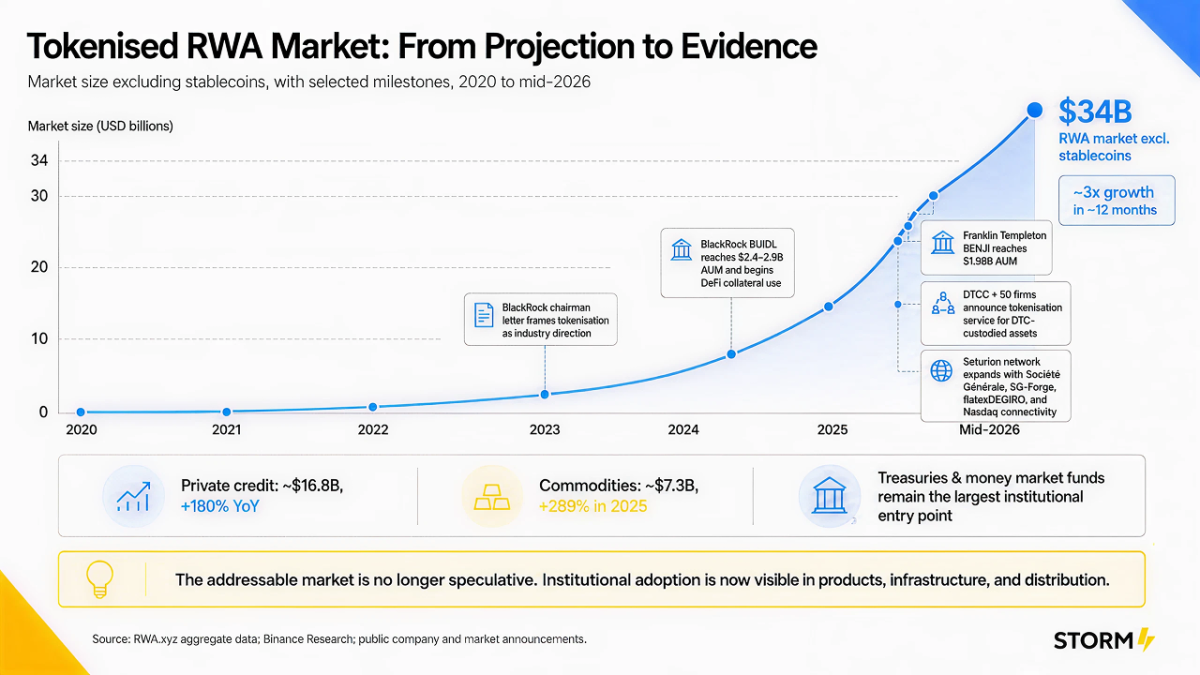
For several years, the case for tokenised securities rested heavily on forecast figures, Standard Chartered projecting $30 trillion by 2030, McKinsey revising that down to $2 to 4 trillion, with the gap between estimates wider than the market itself. Tom Rieder from ISP Group opened his keynote with that observation, noting that the current tokenised RWA market at approximately $34 billion excluding stablecoins [6]. That figure has tripled in roughly twelve months.
The composition of that $34 billion is instructive. Tokenised US Treasuries and money market funds dominate, for reasons both speakers explained clearly: they were the first instruments with enough regulatory familiarity and institutional demand to attract serious capital. Tokenised private credit has grown 180% YoY to approximately $16.8 billion [7]. Tokenised commodities stand at $7.3 billion, up 289% during 2025 alone [7].
The momentum runs deeper than individual products. The institutional commitments behind them are equally hard to ignore. BlackRock's BUIDL fund holds between $2.4 and $2.9 billion in AUM and recently began operating as collateral within DeFi protocols via Uniswap, the first time a regulated institutional fund has crossed that boundary [8]. Franklin Templeton's BENJI suite reached $1.98 billion in AUM as of April 29, 2026, marking five years as the first US-registered mutual fund on a public blockchain [9]. Its patent-pending Intraday Yield feature now calculates and distributes yield to the second, including weekends and public holidays [10]. On May 4, 2026, DTCC announced that 50 firms, including UBS, BlackRock, Goldman Sachs, J.P. Morgan, Franklin Templeton, and Ondo Finance, are collaborating on a tokenisation service covering DTC-custodied assets, with limited production trades planned for July 2026 and a full launch in October [11]. DTC custodies over $114 trillion in assets. The addressable market is not speculative.
Only three weeks before the event, Societe Generale and its digital asset subsidiary SG-Forge both joined Seturion, the pan-European settlement platform of which BX Digital is the Swiss instance, alongside flatexDEGIRO, Germany's largest online broker with 3.5 million retail clients [12]. Societe Generale will issue tokenised structured products; SG-Forge will provide settlement via its MiCA-authorised EURCV and USDCV stablecoins.
Nasdaq will also integrate with Seturion for European trading venue connectivity [12]. The rails Switzerland built are being adopted across the continent.
Larry Fink framed the end state of this in his 2023 BlackRock Annual Chairman's Letter, and the framing has only become more accurate since:
The investment industry is moving from albums to playlists, where every investor has a personalised portfolio, the platform knows what you hold and suggests the next position, and the whole lifecycle is automated on-chain [13].
That is not marketing language. BlackRock manages more than $11 trillion in assets and its chairman used his annual letter to argue that tokenisation is how the industry gets there.
The honest counterargument, and why it makes the story stronger
The secondary market infrastructure is necessary but not sufficient. An exchange does not create liquidity by itself. Tokens do not make bad assets good ones. Investors evaluating a tokenised real estate product in Spain still want to know what the underlying asset is worth, what the legal framework looks like across multiple jurisdictions, and how they exit if they need to. Tokenisation itself does not answer those questions.
What tokenisation changes is the cost and friction around assets that already pass those tests. Stripping out the intermediary layers, compressing settlement times, and removing cross-border friction: that is the architecture problem tokenisation is designed to solve.
Tom's framing for the realistic path forward: markets need market makers, not just exchanges. Compliant distribution requires custodians with digital asset infrastructure and banks willing to route order flow. On-chain identity and wallet compliance remains a manual bottleneck at most TradFi institutions. That is a transition problem, not an architectural one.
The longer-term promise is that compliance becomes embedded rather than layered on: smart contracts that enforce transfer restrictions, investor eligibility, and reporting obligations automatically. FINMA has signalled a potential move away from mandatory counterparty pre-approval toward a risk-based screening approach, where tools like Chainalysis and Elliptic flag wallets with exposure to sanctions or criminal activity rather than requiring every counterparty to be whitelisted in advance [14]. If that direction is confirmed in implementing regulations, it would meaningfully reduce the compliance overhead at the TradFi/DeFi boundary.
ISP Group's own position in this ecosystem illustrates what the market actually needs more of. They serve as paying agents for more than 90% of structured products listed on Swiss exchanges, as a FINMA-regulated custodian, as a liquidity provider on BX Digital, and as a tokenisation partner for issuers looking to bring assets on-chain [15].
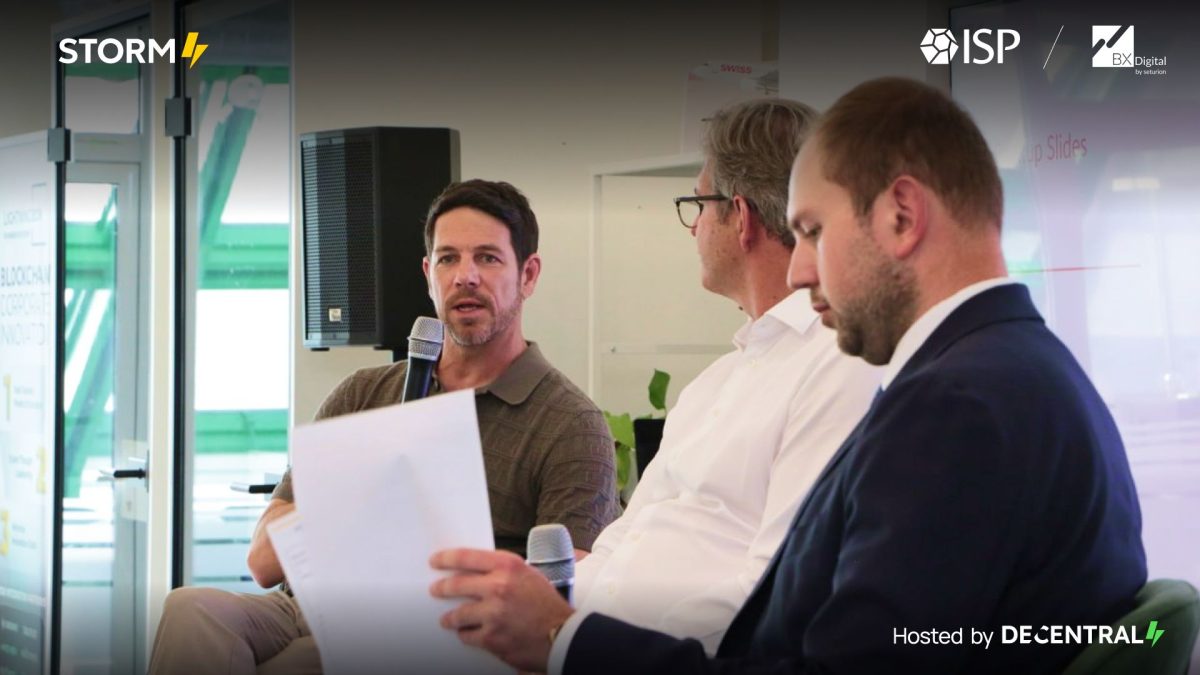
The fireside discussion, moderated by Nicola Massella, Legal Partner at STORM Partners, shifted from operational mechanics to a broader question: tokenisation's ability not just to improve existing market infrastructure, but to bring entirely new asset classes into reach. Private infrastructure debt, royalty-linked instruments, fractional claims on assets that have historically been illiquid or inaccessible below institutional ticket sizes — these are instruments the traditional system cannot distribute efficiently. The cost of intermediation has always made the economics unworkable at scale. Tokenisation changes that equation by removing the floor.
For this to work, the legal architecture has to match the ambition. Swiss law provides a foundation that many jurisdictions cannot: a tokenised claim on a physical or financial asset can constitute genuine co-ownership of the underlying property, a real property right rather than a synthetic exposure or a financial derivative. For lawyers, compliance officers, and risk committees authorising exposure to asset classes they have not encountered before, that kind of structural clarity is not a detail. It is the condition for participation.
The one gap that matters most: Switzerland still does not have a digital franc
Claudio used a striking analogy late in the evening. BX Digital has built an electric car. The electricity does not yet exist at scale, so for now it can also run on petrol, like a hybrid car. The workaround is pragmatic: because BX Digital is a regulated entity, it can trigger the fiat money rails that banks already use for settlement, effectively bridging the on-chain asset leg against off-chain cash. That functions operationally, but it is not the endgame.
The endgame is true instant settlement: digital asset and digital cash on the same ledger, moving simultaneously, with no intermediary between them and no national settlement boundaries. For that to work in Swiss francs, Switzerland needs a Swiss franc stablecoin with meaningful adoption, which it does not currently have.
A digital identity layer is the second missing piece. Switzerland's federal e-ID system is not expected live until late 2026, leaving on-chain KYC at the scale full settlement requires still absent. On April 8, 2026, UBS, PostFinance, Sygnum, Raiffeisen, Zürcher Kantonalbank, Banque Cantonale Vaudoise, and Swiss Stablecoin AG launched a joint sandbox running throughout 2026 on Ethereum, with outstanding volume capped below CHF 1 million to fit the fintech sandbox regime [16]. That is a signal of intent, not a solution.
The largest CHF stablecoin currently in operation falls outside the regulatory framework being designed to govern it. Frankencoin is structured as an association and holds neither the corporate form nor the CHF 25 million minimum issuance threshold the proposed regulations require [17]. The gap between regulatory ambition and current market reality is that precise.
The broader market context makes the timeline pressure visible. The stablecoin market cap stood at approximately $322 billion as of May 26, 2026 [18], with stablecoin issuers collectively holding an estimated $182 to $200 billion in US Treasuries [19], making them a structural buyer of sovereign debt at a scale that now shapes government financing conversations in Washington.
Per Tether's Q3 2025 attestation, Tether held $135 billion in US Treasury exposure, positioning it as the 17th-largest holder of US government debt globally [20]. Circle, the USDC issuer, held approximately $50 billion in US Treasuries by late 2025, making the two stablecoin issuers together among the largest non-sovereign holders of US government debt in the world. That dynamic did not emerge by accident.
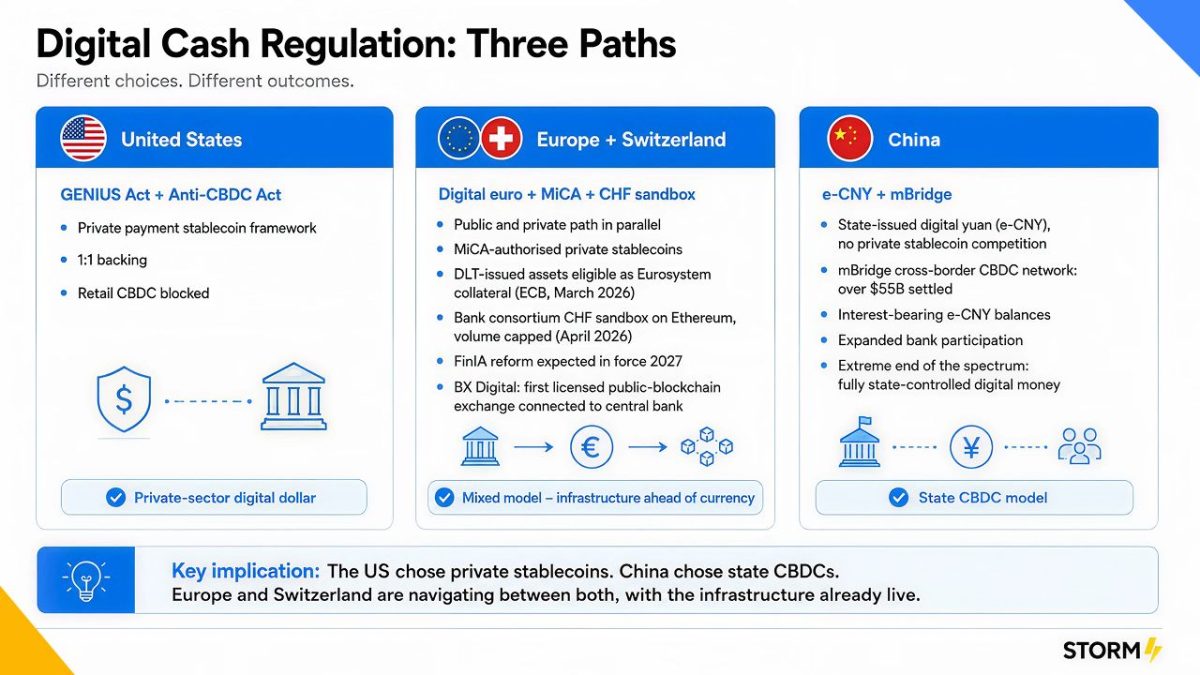
The GENIUS Act, signed into law in July 2025, established a federal framework for private payment stablecoins backed 1:1 by cash or short-dated Treasuries [21], while the companion Anti-CBDC Surveillance State Act prohibited the Federal Reserve from issuing a retail digital dollar [22]. Together they represent a deliberate policy choice to route the digital dollar infrastructure through the private sector and extend American monetary reach through stablecoin distribution channels.
Europe is pursuing the mixed path, with the ECB digital euro in development alongside MiCA-authorised private stablecoins. The ECB confirmed in March 2026 that DLT-issued marketable assets are eligible Eurosystem collateral [23].
The third path runs through Beijing. China prohibited private stablecoin issuance entirely and built the e-CNY as the state's sole digital payment instrument at scale. By late 2025, it had processed over 3.4 billion transactions worth approximately 16.7 trillion yuan; in January 2026, the PBOC introduced interest-bearing e-CNY balances, reclassifying the instrument from digital cash to deposit currency. Project mBridge, the cross-border layer, links the central banks of China, Hong Kong, Thailand, the UAE, and Saudi Arabia and had settled over $55 billion in transactions by early 2026, with China's e-CNY accounting for roughly 95% of volume and operating as a parallel settlement rail outside the dollar-correspondent system [24]. The BIS exited the project in late 2024; settlement has accelerated since. The structural choice is the most explicit of the three: fully state-controlled digital money, with the infrastructure already live.
Switzerland, which built the first licensed public-blockchain settlement infrastructure in the world, is still deciding. A German issuer is already building a CHF-denominated stablecoin. SocGen's structured products will settle in EURCV on the same infrastructure BX Digital uses for Swiss operations. The settlement currency running through the rails Switzerland built is increasingly likely to originate elsewhere if the domestic timeline does not accelerate.
The legislative path is clearing but slowly. The Federal Council's proposed FinIA reform creates a Payment Instrument Institution category for regulated stablecoin issuance and a Crypto-Institution category for custody and trading, with entry into force expected in 2027 [16]. Critically, under the current draft, Swiss banks cannot issue regulated stablecoins directly but must establish a separate subsidiary holding a Payment Institution license, a structural constraint the Swiss Bankers Association has publicly contested.
What the room took away
The evening ended with a networking cocktail and conversations that continued well past 21:00. The audience included a financial investigations officer, a project team tokenising Spanish real estate for Swiss distribution, and someone actively building the CHF stablecoin infrastructure the market is waiting for. That is what a maturing ecosystem looks like: the problems are specific, and the people working on them are already in the same room.
The gaps that remain, a regulated CHF stablecoin and a live national digital identity layer, are real and being worked on. The bank consortium sandbox launched in April; the FinIA reform is in motion. What BX Digital and ISP Group demonstrated over the course of the evening was the distance already covered: a licensed production exchange settling tokenised securities on public Ethereum against central bank money, a paying agency infrastructure covering more than 90% of structured products listed on Swiss exchanges, and institutional commitments from Nasdaq, SocGen, and flatexDEGIRO to the same rails.
Switzerland's position is one of demonstrated capability with known gaps. The world's first licensed public-blockchain exchange connected to the Swiss National Bank is in production. The legal framework gives tokenised assets genuine property rights. Few jurisdictions can put those claims in the same sentence.
Closing the remaining gaps is the work ahead, and it is the kind that gets done when builders, compliance officers, issuers, and regulators stay in the same room. Decentral House is here to make sure that conversation keeps happening.

Thank you to Claudio Tognella and BX Digital, and to Tom Rieder and ISP Group, for bringing a substantive and candid conversation to Geneva and for trusting Decentral House as the venue.
Thank you to Nicola Massella for the sharp moderation, and to everyone who attended and contributed to one of the more worthwhile evenings this space has produced in some time.
STORM Partners advises institutions navigating digital asset strategy, tokenisation, and regulatory positioning across Swiss and European markets. If these questions are live in your organisation, we would be glad to think through them with you → storm.partners
If you are interested in hosting a similar event or seeking domiciliation services in Geneva to leverage Switzerland's financial and DLT regulatory framework, please reach out to Decentral House → decentral.house
Annex: Sources
[1] Zenith Optimedia / Publicis, Advertising Expenditure Forecast, 2019. Reported by Marketing Dive, "Study: Social Media Overtakes Print for 1st Time in Global Ad Spending," October 8, 2019. marketingdive.com
[2] FINMA, "FINMA licenses first DLT trading facility," press release, March 18, 2025. finma.ch/en/news/2025/03/20250318-mm-dlt-handelssystem
[3] Baker McKenzie Blockchain Blog, "Swiss Regulator Issues a First DLT Trading Facility License to BX Digital AG," April 16, 2025. blockchain.bakermckenzie.com
[4] CapLaw, "BX Digital: The First DLT Trading Facility in Switzerland," 2025. caplaw.ch
[5] FintechNews Switzerland, "BX Digital Begins Onboarding for Switzerland's First Licensed DLT Trading Facility," 2025. fintechnews.ch
[6]Crypto.news,"Tokenized real world assets triple to $34 billion as Treasuries and Ethereum lead," May 2026. crypto.news; RWA.xyz aggregate data.
[7] InvestaX, "Q1 2026 Real World Asset Tokenization Market Report. "investax.io; 4irelabs, "Real World Asset Tokenization 2026." 4irelabs.com
[8] RWA.xyz; The Block, BlackRock BUIDL fund data, 2026.
[9] Franklin Templeton / Stellar Development Foundation, joint press release, BENJI five-year milestone, May 8, 2026. stellar.org
[10] Franklin Templeton, "Franklin Templeton Launches Patent-Pending Intraday Yield Feature on Benji Technology Platform," June 10, 2025. Nasdaq.com; Decrypt, "Franklin Templeton Unveils 'Intraday Yield' for Tokenized Assets on Benji Platform," June 10, 2025. decrypt.co
[11] DTCC press release, DTCC Industry Working Group tokenisation announcement, May 4, 2026. dtcc.com
[12] Finews, "Nasdaq, Boerse Stuttgart, BX Digital Build European Settlement Infrastructure," May 2026. finews.com; CoinCentral, "Boerse Stuttgart Taps SocGen, FlatexDEGIRO for Blockchain Push," May 21, 2026. coincentral.com
[13] Larry Fink, BlackRock Annual Chairman's Letter to Investors, March 2023. Republished via Harvard Law School Forum on Corporate Governance, March 17, 2023. corpgov.law.harvard.edu
[14] Crypto Valley Journal, "FINMA tightens crypto supervision and warns of consumer risks," 2026. cryptovalleyjournal.com
[15] ISP Group digital asset services overview; Taurus, "Taurus Launches First Interbank Network for Digital Asset Collaboration," 2025. taurushq.com
[16] Swiss Federal Council, proposed Financial Institutions Act (FinIA) reform, consultation closed February 6, 2026. admin.ch; FINMA Guidance 01/2026, January 12, 2026.
[17] Frankencoin Protocol. frankencoin.com. Referenced in "The Romans Never Saw Crypto Coming," STORM Partners / Good Token Society roundtable recap, March 2026.
[18] CoinDesk, "At $322 Billion, the Stablecoin Market Value Exceeds the FX Reserves of 95 Nations," May 26, 2026. coindesk.com
[19] Apollo Global; Bitwise; ARK Invest, "Stablecoins Could Become One of the US Government's Most Resilient Financial Allies," 2025. ark-invest.com; Bitbo, "Stablecoin Issuers Now Hold $182B in US Treasuries." bitbo.io
[20] Tether, Q3 2025 Attestation Report. tether.io; CoinDesk, "Tether's Gold Holdings Top $17 Billion as Net Profits Surpassed $10 Billion for 2025," January 30, 2026. coindesk.com
[21] Skadden, "US Establishes First Federal Regulatory Framework for Stablecoins: The GENIUS Act Passes Congress and Awaits President Trump's Signature," July 2025. skadden.com; Federal Register, "GENIUS Act Requirements and Standards for FDIC-Supervised Permitted Payment Stablecoin Issuers," April 10, 2026. federalregister.gov
[22] Columbia Law School CLS Blue Sky Blog, "Do the Anti-CBDC Surveillance State Act and the GENIUS Act Jeopardize U.S. Digital Finance?", August 11, 2025. clsbluesky.law.columbia.edu
[23] European Central Bank, confirmation of DLT-issued assets as eligible Eurosystem collateral, March 30, 2026. ecb.europa.eu
[24] Atlantic Council CBDC Tracker, January 2026. atlanticcouncil.org/cbdctracker; Reuters, "mBridge tops $55 billion in transaction volume," January 17, 2026. reuters.com